Showing posts with label seed. Show all posts

23 August 2011

Potato Cake/Bread

With sundry scrumptious potatoes, what better thing to bake than potato cake/bread?! Banana bread and pumpkin bread exist; surely potato bread (NO, NOT THE LOAF/SLICE VERSION AT THE STORE) is the next best thing ever? Carbs on carbs? I found a banana bread recipe and used it as the basis for my potato bread/cake. My sister says that it looks more like a brownie than a bread (true, because it doesn't really rise), but it has banana-bread-like crumbs, and is very moist, so I would be inclined to say that it's a muffin... even though it's not muffin shaped.

The best part? Everyone in the family, INCLUDING MY SISTER, eats it. My sister, the most fastidious person in the house when it comes to food (she has to have her dinner arranged EXACTLY, has to eat certain foods with a FORK ONLY, won't eat in the presence of the smell of mustard etc.) eats potato cake/bread. Whoo!!!

Below are two versions; the normal version, and the lower Calorie version. The lower Calorie version... surprising tastes the same and has a similar texture to the higher Calorie version!! Wonderful! I've made four of these breads/cakes so far, so I've had time to experiment and make adjustments.
INGREDIENTS for a 3 cm tall x 20 cm square pan of cake (1200 cm^3)
120 g butter
30 g brown sugar
40 g white sugar (more if you want something sweeter)

300 g freshly mashed potato
0.75 tsp baking soda
cinnamon
1 tsp nutmeg
vanilla
pinch of salt

40 ml water from the pot you used to boil potatoes
1 tbsp vinegar (optional but highly recommended)
100 g whole wheat flour
100 g nuts, chocolate, dried fruit etc. HIGHLY OPTIONAL.

METHOD
1. Boil water and potatoes. Mash potatoes with baking soda, cinnamon, nutmeg, vanilla, and salt. Keep hot water in pot.
2. Cream sugars with butter. The result is a soothing, creamy, beige substance.If you feel like it, throw in an egg BUT IT IS NOT NECESSARY, and DO NOT ADD WATER in STEP 3.
3. Mix creamed butter with mashed potato, water, and vinegar. Note that the butter melts.
4. Fold in 25 g flour. Do this 4 times. You should have a rather light, gooey batter the consistency of pudding. Throw in OPTIONAL nuts/chocolate etc.
5. Spread evenly into a baking dish (greased with the butter wrapper).
6. Bake on the bottom shelf of an un-preheated oven at 177 degrees F/350 degrees F for 22-25 minutes.
7. Let bread/cake sit in oven for an hour or two or whenever you think it looks cooked.
8. Eat, or freeze it for later.

ALTERNATIVE METHOD if you are running low on time
1. Mix everything in a bowl. It will look ugly and lumpy. Just keep mixing. It will get much smoother.
2. Bake on the bottom shelf of an un-preheated oven at 177 degrees/350 degrees for 25-28 minutes.
3. Stick a fork into the bread/cake and if it comes out clean, it's done.

Because I'm kind of upset with the celerity of butter consumption due to this recipe (120 g of butter within 2 hours...), especially for my mum, I tried to make a lower calorie version that would still neatly crumble, stay moist, and be bready/cakey-textured. It looks the same:
INGREDIENTS FOR THE LOWER CALORIE VERSION (20 cm square pan)
60 g butter
20 g brown sugar
6 sachets of artificial sweetener

300 g freshly mashed potato
0.75 tsp baking soda
cinnamon
1 tsp nutmeg
vanilla
pinch of salt

120 ml water from the pot you used to boil potatoes
1 tbsp vinegar
100 g whole wheat flour
100 g nuts/chocolate/etc. (OPTIONAL)

METHOD
1. Boil water and potatoes. Mash potatoes with baking soda, cinnamon, nutmeg, vanilla, and salt. Keep hot water in pot.
2. Cream sugar and artificial sweetener with butter. The result is a soothing, creamy, beige substance.
3. Mix creamed butter with mashed potato, water, and vinegar. This will look ugly.
4. Fold in 50 g flour. Fold in another 50 g flour. You should have a rather light, gooey batter the consistency of pudding. Throw in OPTIONAL nuts/chocolate etc.
5. Spread evenly into a baking dish (greased with the butter wrapper).
6. Bake on the bottom shelf of an un-preheated oven at 177 degrees F/350 degrees F for 22-25 minutes.
7. Let bread/cake sit in oven for an hour or two or whenever you think it looks cooked.
8. Eat, or freeze it for later.
Again, the lower Calorie version tastes the same as the higher Calorie version, although it looks uglier when you're mixing the ingredients together. Both have similar textures; if you get something that's more gooey than crummy (so, more like coconut pudding than like a cake), you should bake it for a few more minutes.

I made a coconut version, which wasn't as tasty as the plain version, surprisingly (too chunky). The walnut/pumpkin seed version was pretty good, though, and I enjoy encountering chunks of potato, so my next potato recipe will most likely be something sweet with huge chunks of potato.

I know that my opinion doesn't count for this, but the potato bread/cake looks, tastes and feels like banana bread. I think it's the nutmeg, vanilla, and potato texture that sort of... give off a banana-y aura. Neither my mum nor my brother agree with me. Maybe I'm just going bananas. (haha!)

04 August 2011

Jammin' Through the Sieve.

See what I did there?
I put jam through a sieve today.
(terrible pun.)

Because our berry plants don't have any berries this year (perhaps due to the fact that we neglect them), I couldn't complete my yearly berry-jam-making ritual. Okay, not ritual, but tradition. It's only been a two-year tradition, though. Since there are no berries, I decided to make grape jam. Actually, to be more specific and gourmet-sounding, I made organic garden-fresh-but-from-the-wild-part-of-the-garden spherical green grape jam with a hint of mint and lime.
The problem with grape jam is that it looks a bit like pickle juice and I lack the machinery to separate the seeds from the jam/pulp. Therefore, I now have four jars of chunky, perfect textured jam-with-seeds and one jar of thin sifted-jam-without-seeds.

I also realised that I ought to measure everything using metric units because it just makes so much more sense. I did grow up with metric, but I only started cooking a lot when I moved to the U.S., so cooking measurements for me have been the whole cups-tbps-tsp thing instead of grams. Grams are better though, especially since I do have a food scale.
Ingredients for about 1.5 L of jam (5 jars)
12 cups/1560 g green grapes that are spherical and extremely sour (from the grape plant outside)
3 cups/540 g granulated sugar (or more. This one was on the sour side because I like sour jam)
7 mint candies
A few shakes of mint flakes
A spoonful of maltose (just because my mum happened to have some from cooking something; completely optional)
Some lime zest (pectin, optional)

Ingredients for a 300 ml jar of jam
310 g green grapes
110 g granulated sugar, or more, to taste
2 mint candies
Some mint flakes
Some lime zest

Method
1. The night before, stick everything in a pot. I didn't do this, but the osmosis should help reduce cooking time the next day.
2. Turn heat on high and stir. Don't be afraid of scorching any grapes.
3. 20 minutes later, there should be liquid at the bottom of the pot and the grapes should still be sort of hard, but some will be mushy. Keep stirring and wait for the water to boil. The grapes will turn from bright green to... olive-coloured.
4. Turn heat onto medium-low and let it simmer for about 2 hours, stirring every 10 minutes or so. All the grapes should be mushy now! The jam will look ugly. You can check the gooeyness of the jam by dropping some jam onto a plate, letting it cool, and seeing if it is the consistency you want. You can also adjust the sweetness at any point in the 2 hours.
5. If you really want to, sift jam into jar. I tried to do this for the first jar, but it didn't work because I don't have a sieve that everything except the seeds flow through. I also wanted the grape skins (basically, everything except for the seeds). I suppose this is the negative side of making grape jam with non-GMO grapes.

6. Wait for jar of jam to cool, then stick it in the fridge. I know you're supposed to do stuff with the jars with the water bath in order to sterilise the jars, but since we're sticking the jam in a fridge and consuming the jams (yeah... all 5 jars...) within a few months, I don't think that this is necessary. In addition, there is a lot of acid in this specific batch of jam. The grapes were really sour.

So now I know why you don't see green grape jam at the grocery store. It doesn't look that appetising. Seriously, though, this jam is way better than the store-bought flavourless and textureless jam!!

22 July 2011

Baked Acorn Squash and Seeds

Despite it being something like 38-9 degrees C today, I was determined to finish the acorn squash in my fridge. Right now, all that's in my fridge is about one serving of Colby-Jack cheese, a pound and a half of carrots, one tomato, cherry cough drops, and those disgusting candy sticks from a while ago. I need to clear out my fridge by the 28th so that it can defrost properly. I also have two cans of beans, a tube of polenta, and some amount of oat bran left.

I wanted to make acorn squash and chips but after not being able to slice the chunks thinly enough, I figured, eh, I'll just bake them. Bake them without oil or seasonings at 400 degrees F for some 15-or-something minutes.

I also toasted/baked the acorn squash seeds, and they smelled phenomenal! They smelled like... popcorn.
They tasted like... popcorn. Slightly. I loved it!
I actually also love baked acorn squash! It's deliciously sweet (but not too sweet) and has a potato-y texture! The acorn squash skin also smells and tastes like nori. What an interesting plant... popcorn, nori, and a delicious sweet interior...

The "baked" carrots, however, were still half raw when I ate them. They were a little sweeter than usual, but it wasn't too much to talk about.

24 August 2010

Eight Treasures Rice

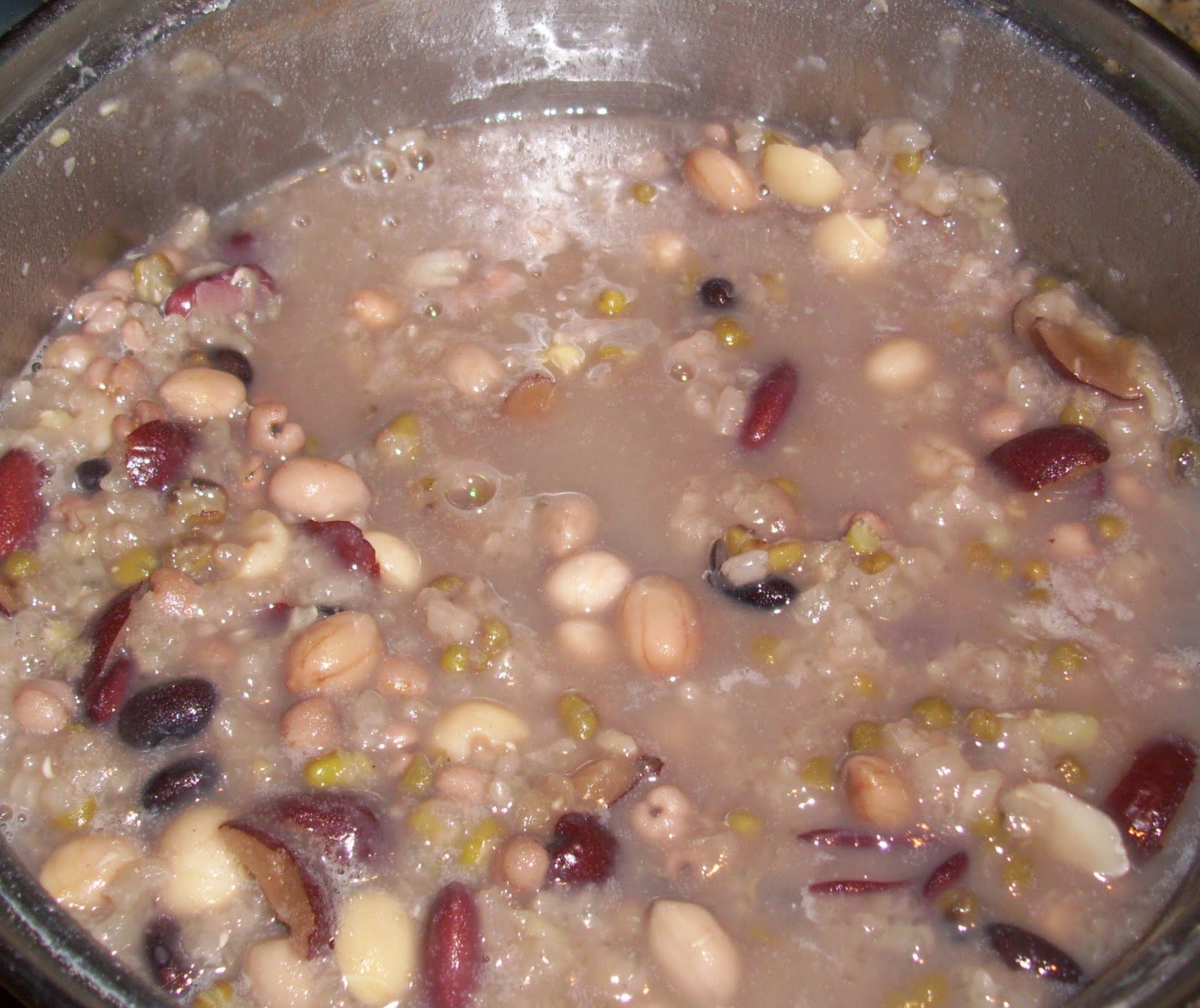
I love rice pudding. With raisins, with cinnamon, with milk, or just plain... I love the gooey yet chewy texture. My mum today made some ba[1] bao[3] fan[4], which translates literally to "eight treasures rice". It's basically glutinous rice, another type of rice, kidney beans, mung beans, peanuts, lotus seeds, jujube berries, black beans, and there may be a few other ingredients [but it's okay, because I've already named 8 of them!]
Although I'm not really going to miss eating Chinese food every single day, I AM going to miss my mum's cooking.

With milk! Sans sugar.

08 August 2010

Blood Test Soup...

I got another blood test yesterday morning, and I went home feeling fine. Little did I know that it would set up a perfect excuse for me, 12 hours later... [That's another story...]
My mum always makes this soup for me after a blood test. It's basically sugar, water, jujube berries, peanuts, white wood ear, a longyan/lychee-type thing, and lotus seeds. It's actually quite delicious if you add milk to it. Anyway, on the way back, my mum and I were discussing the soup. She claims that we're supposed to use rock sugar to sweeten the soup, rather than plain old granulated or caster sugar, since it's "sweeter" to use rock sugar. Urban myth also claims that using rock sugar is better since it adds a ton more nutrients to the soup, since it "melts" slower. My mum also said that the caster sugar "disappears" when put in soup, so you have to use rock sugar since it "cooks for longer".
I am here to disprove these ideas. Scientifically speaking.
1. If you have a chunk of rock sugar, and you emulate that chunk with granulated sugar, you will not get the same "sweetness" of sugar. I mean, if you have a cube of rock sugar, and you have a sugar cube, even though the volume is the same, the moles of sucrose is evidently not the same. There is a ton of air between each granulated sugar crystal in the sugar cube, whereas in a chunk of rock sugar, there is less air in a sugar crystal, let alone between each sucrose molecule. In fact, if you were to weigh the cube of rock sugar, it should definitely be heavier than the granulated sugar cube. So, more sucrose means sweeter soup. Simple.

2. Rock sugar is sucrose. Granulated sugar is sucrose. "Organic Evaporated Cane Juice" is sucrose. Brown sugar is sucrose, with some molasses mixed in. Sure, there may be "trace" minerals and blah from the refinement and treatment processing from when the cane or beet juice was evaporated. It's all one glucose covalently bonded with one fructose. In water, a chunk of sucrose molecules dissolves into individual sucrose molecules. Even if there were trace nutrients, you'd have to eat kilos of that sucrose to perhaps obtain 1% of your daily intake of some nutrient...

3. Both caster sugar and rock sugar dissolve in water. They both stay dissolved in the water. Sucrose doesn't just "disappear". Both caster sugar and rock sugar don't "cook" at 90 or 100 degrees C. They just stay dissolved.

I like this soup though. I'm glad my mum bothers to dump everything in the slow cooker and leave it on overnight.